
Joseph Dando, the Younger (my 3 x great-grandfather), was a figure who navigated the competitive world of 19th century commerce and left a visible mark on history. Born in Bristol, Gloucestershire, and later active in Philadelphia, USA, during the 1830s and 1840s, Joseph built a career as a bookkeeper, teacher, and author. Contemporary newspapers praised his innovative bookkeeping methods and his efforts to train young men for careers in commerce. At the same time, like many entrepreneurs of his era, he was not without his faults, as I’ve found in other chapters of his life. He wasn’t simply a success story, but a complicated man whose ambitions, choices, and flaws are as much a part of his legacy as his innovations. This aspect of his journey is less about a flawless hero and more about a man navigating the opportunities and challenges of a rapidly growing American city.
From Bristol to New York and Philadelphia: The Rise of an Entrepreneur
Joseph began life in Bristol but his ambitions led him across the Atlantic and by 1835, he’d already developed his own method of bookkeeping in New York. The Journal of the Franklin Institute of Pennsylvania stated that his system, described in a series of four books, was a marked improvement over the traditional “Italian system” of double-entry bookkeeping, long criticised for being tedious and cumbersome. At the heart of his innovation was a “Journal of Settlements”, which streamlined accounting procedures and made it far more efficient. This early recognition paved the way for his eventual move to Philadelphia, where he would cement his reputation.

One of Joseph Dando’s Advertisements –
Public Ledger (Philadelphia, Pennsylvania) dated 8th August 1839
By 1839, Joseph had been in Philadelphia for about three years and he’d opened the “Institute for Book-keepers” and “Dando’s Institute for Accountants” at the southeast corner of Fifth and Walnut Streets. Advertisements from this period show him as a respected figure, with multiple “Recommendations” from prominent local businesses. These included Sampson Tams who was a merchant and importer specializing in selling various wares, primarily china, glass, and other goods and who ammassed a significant fortune, and also Frederick Fraley who was an American businessman, politician, and civic leader from Philadelphia, a co-founder of the Franklin Institute and who served as president of the American Philosophical Society. These endorsements not only reinforced Joseph’s credibility but also positioned him as a trusted source for aspiring accountants.
Educator, Author and Mentor
Joseph’s contributions went beyond his own bookkeeping. He trained young men in the practical and theoretical skills they would need in Philadelphia’s commercial sector. His advertisements served a dual purpose – inviting young men to study bookkeeping under his guidance, while also informing local businesses that competent and trustworthy bookkeepers were available through his institute. Students praised his method for combining hands-on experience with solid theory, preparing them for real-world work in the counting houses of the city.
In 1842, he published “A Complete and Infallible System of Book-Keeping by Double Entry”, allowing his innovative methods to reach an even wider audience and setting a standard for accounting practice at the time. An article in the New-York Spectator from 2nd November 1842, highlighted his reputation as a “scientific and practical accountant and teacher of book-keeping, of the very first class” in both New York and Philadelphia. It stated the book was “beautifully printed on fine paper” and was for sale by the author in Philadelphia and was also available through Stephen Dando (Joseph’s uncle) at 401 Pearl Street, New York.
A Shrewd Businessman
Joseph was not only a teacher and author but also a keen businessman. By 1844, he’d relocated to No. 31 Merchants’ Exchange on South Third Street. In 19th century Philadelphia, the Merchants’ Exchange was a prominent hub for commerce – a central building where merchants, brokers, and financial professionals conducted business. Being located there would have been a strategic choice – it placed Joseph at the centre of the city’s commercial activity, making his bookkeeping instruction highly visible and convenient for the businesses and students he served. Advertisements show he adjusted his fees to be more accessible – “five dollars below the former charges” – showing his adaptability and understanding of the city’s changing economic landscape.

The Merchants’ Exchange, Philadelphia
Lithograph published by J.T. Bowen in 1840
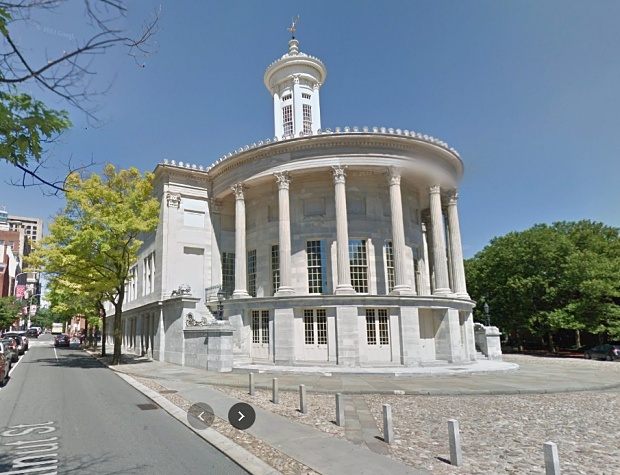
The Merchants’ Exchange – 2017 (Google Street View)

The Opposite Side of The Merchants’ Exchange on S 3rd Street – 2024 (Google Street View)
Through his teaching, publications, and ability to adapt, Joseph Dando was more than just a bookkeeper. He was a pioneer in commercial education, a respected author, and a vital link between aspiring young men and the businesses that needed their skills.
Later Career
After his years in Philadelphia, Joseph returned to England, probably around 1845, and spent a period of time working in the family’s hat-making business in Bristol. He established an accountancy firm in Manchester in around 1857 and later entered into a brief partnership with his son, William Elbert Dando, running an auditors and accountancy business there. During the mid 1860’s, he relocated to Belfast, Ireland, where he resumed practising on his own until he died in 1870. These later years show a man still engaged with his profession, adapting to new circumstances, and passing on his skills to the next generation.
